NeuroStability Training Pkg of 5
Appointment Length
1 hour 0 minutes
Service Description
You are still getting everything done. Deadlines met, people taken care of, decisions made. From the outside you look capable and dependable. Underneath, you are tired in a way that sleep is not fixing.
Rest does not feel restorative. Your mind stays busy the moment you stop. You are shorter with the people you love than you want to be, and you cannot point to one clear reason why.
People often book a first session when they are experiencing
• Waking up tired even after a full night of sleep
• A mind that will not slow down at night
• Replaying conversations after the day is over
• Brain fog, forgetfulness, or difficulty concentrating
• Feeling tense or on alert even when nothing is wrong
• Irritability, or less patience than they used to have
• Feeling emotionally flat, numb, or unlike themselves
• Feeling guilty or restless when they rest
• Being capable on the outside and depleted underneath
What happens in a first session
The first session runs 90 minutes rather than the standard 45. The additional time is for an assessment and a conversation about what you have been noticing — how you sleep, where your attention goes, what your days ask of you.
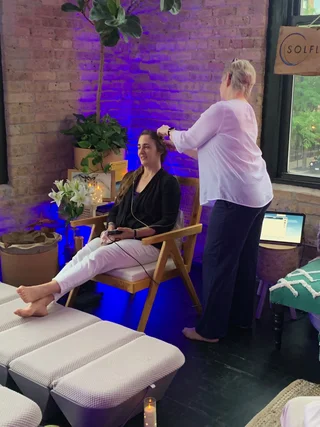
Then the training itself. Sensors are placed on your scalp and ears. You sit in a chair and listen to music. There is nothing to concentrate on, nothing to correct, and nothing you can do wrong. Most people close their eyes. Some fall asleep.
What neurofeedback is
The system reads your brain's electrical activity and interrupts the audio at moments of abrupt change. Your brain notices the interruption and adjusts. Nothing is sent into you. No frequency is targeted, no protocol is prescribed, and nothing is being fixed from the outside.
This is the part people find strange at first: it does not require effort. You are not being trained to do something differently. Your nervous system is simply being given information about itself.
What people notice
Responses vary and are individual. People commonly report sleeping more deeply, settling more easily at the end of the day, and being less reactive to things that used to set them off. Some notice something after the first session. For most, it accumulates.
Neurofeedback is not medical care and is not a substitute for it. NeurOptimal® is not used to diagnose or treat any condition. Persistent, severe, or unexplained symptoms should be discussed with a qualified healthcare professional.
This is a session, not a consultation
You are booking training time, not a call to decide whether to book. If you would rather start by reading, MoreYou.app and my writing are free and open to anyone.
Mary Meduna-Gross, Ph.D. is a NeurOptimal® trainer in Wicker Park and the founder of PlenaVita Shift. She is a Gulf War veteran and has spent two decades around people who function well under pressure — and who know the difference between functioning and being well.
Less Struggle. More You.
Service Requirements
Before we meet, please complete two things in the MoreYou app — both free:
Aliveness Profile — a short assessment that gives us both a starting point.
What's True for Me Now — space to say, in your own words, where things actually stand.
MoreYou.app
Take your time with it. We'll look at what you share together when we talk.
FAQs
Q: What can NeuroStability help me with?
A: People come to NeuroStability carrying a wide range of experiences. What they have in common is that what they've already tried hasn't been enough. NeurOptimal® has shown meaningful results across:Sleep disturbanceDifficulty falling asleep, staying asleep, or waking unrestoredAnxiety/Persistent background worry, Vigilance, reactivityStress/Chronic pressure that doesn't lift between demandsFocus & concentrationAttention that won't hold, Mental fatigue/Burnout; The particular exhaustion of someone who has been running on empty for too long.Depression Low mood, flatness, loss of access to what used to matterPTSD & traumaThe nervous system stuck in a response it can't exitAnger & irritability; A short fuse that feels out of proportionMood instability; Swings that feel disconnected from circumstancesChronic pain, fibromyalgia, migrainesConditions where the nervous system's dysregulation is felt in the body
Q: What is NeurOptimal neurofeedback?
A: NeurOptimal® is a brain training system that gives your nervous system real-time information about its own activity. During a session, sensors placed on your scalp read your brain's electrical patterns. When the system detects a moment of turbulence — an abrupt shift in activity — it signals the brain with a brief interruption in the music you're listening to.That's it. No electricity. No medication. No active effort on your part. Just information, delivered at the moment the brain can use it.Over time, the nervous system uses that information to reorganize — moving out of the survival patterns that have kept it braced, and toward the efficiency and effectiveness that are its natural state.
Q: How does it know when to send a signal?
A: NeurOptimal® monitors your brain's electrical activity across all frequency bands simultaneously — not just one or two, as other neurofeedback systems do. It's watching the overall dynamical properties of your brain's activity in real time. When it detects a moment of turbulence — a sudden, abrupt shift in that activity — it interrupts the music for a fraction of a second. Not to correct anything. Not to push your brain in a particular direction. Simply to say:this just happened.The signal is precise, automatic, and completely specific to your brain in that moment. No two sessions are identical. The system isn't working from a protocol designed for someone else's diagnosis. It's responding to you — only you, only now.
Q: How does my brain know what to do with the signal?
A: This is the question that stops most people — because the answer runs counter to everything we've been taught about change.We assume change requires effort. Insight. The right strategy applied consistently over time. We assume the brain needs to be taught.It doesn't. The brain is a self-organizing system. Given accurate information about its own activity, it knows how to use it. This isn't a theory — it's the same principle that allows a cut to heal without you managing the process, or your balance to correct itself when you stumble without you deciding how.What NeurOptimal® provides is the information. What your brain does with it is not our business — and that's precisely the point. We're not steering toward an outcome. We're not deciding what optimal looks like for you. The nervous system, offered a clear signal at the right moment, does what it has always been capable of doing.It finds its own way back.
Q: What will I notice and when?
A: This is where most people want a clear before-and-after picture. A measurable result. Proof that something happened.The honest answer is that it doesn't work that way — and understanding why is part of what makes NeurOptimal® different from almost everything else you've tried.What shifts with NeurOptimal® is the nervous system's baseline. Not a symptom you can point to, but the ground everything else runs on. Which means the changes tend to show up indirectly — in what's no longer happening as much, or as intensely, or as automatically.Sleep that feels different. A reaction that didn't escalate the way it usually does. A morning that didn't start in deficit. The background hum a little quieter than it was.Most people notice something after the first session — a quality of rest they didn't expect. Deeper shifts tend to emerge over multiple sessions, at a pace the nervous system sets, not one we impose.Because the changes are experiential rather than linear, we use MoreYou.app to track your patterns week to week — not as clinical data, but as a way of noticing what's shifting in your actual experience over time. The app becomes a mirror for the process the sessions are quietly moving.
Q: How is this different from therapy or meditation?
A: A useful question — especially if you're already doing both.Therapy works with the mind. It builds insight, reframes narrative, processes experience. It's valuable. It's also aimed at the thinking layer — which, as we've established, doesn't reach the nervous system directly.Meditation builds the capacity to observe. Over time it can shift your relationship to what arises. But it asks something of you — presence, practice, the ability to stay with discomfort. When the nervous system is locked in survival mode, that ask can be its own form of effort.NeurOptimal® works underneath both. It doesn't require insight or effort or the ability to stay still in a particular way. It works at the level where the habit of struggling actually lives — in the nervous system itself, below the reach of thinking or observing.This isn't a replacement for therapy or meditation. For many people it's what makes both of those practices finally land — because the nervous system is no longer bracing against them.
Q: What does a session actually feel like?
A: Quiet. That's the word most people reach for afterward.You'll arrive for a brief conversation about where you are — what you've been noticing, what brought you here. Then you settle into a comfortable chair, sensors are placed on your scalp and ears, and you listen to music while the system does its work.You can rest. Read. Simply be still. The only requirement is that you don't move around too much — the sensors need to stay in place. Most people find the session genuinely restful in a way that surprises them.There's nothing to do. Nothing to figure out. Nothing to get right.The session runs for about 30 minutes. Most people leave feeling quieter than when they arrived — rested in a way that's different from sleep, settled in a way that's hard to name but easy to notice.
Q: How many sessions do I need?
A: There's no protocol-driven answer here — and that's intentional.Because NeurOptimal® isn't pushing your brain toward a predetermined outcome, there's no fixed number of sessions required to get there. The nervous system moves at its own pace, in its own sequence. We don't override that.What the research shows is that most people begin noticing shifts after the first few sessions. Anxiety symptoms tend to respond earlier than attention and focus challenges — though both show meaningful improvement over time. Deeper, more lasting reorganization tends to emerge with continued training.Some people come weekly. Some come more frequently when they're in a particularly demanding season. Some return periodically for maintenance — not because the effects wear off, but because life keeps generating new pressures, and the nervous system benefits from continued support.The most honest answer: start with one session. Notice what shifts. Let that inform what comes next.
Q: Is it safe?
A: NeurOptimal® has no known harmful side effects. It is non-invasive — nothing enters the body, no electricity is introduced, nothing is being pushed into or pulled from the brain. The sensors simply read electrical activity that is already there.The system is classified by the FDA as a general wellness device. It has been used safely with people across the full lifespan — from young children to elderly adults, including people with complex and sensitive presentations.Because NeurOptimal® doesn't target specific outcomes or attempt to reshape brain activity in predetermined ways, there is no risk of pushing the nervous system somewhere it shouldn't go. It offers information. What the brain does with that information is always its own choice.The most common experience after a session is feeling rested. Occasionally people notice a temporary increase in dreaming or a brief period of fatigue as the nervous system integrates new information. Both are signs of reorganization, not harm — and both pass.
Q: Is it covered by insurance?
A: NeuroStability sessions are not covered by insurance — and understanding why is actually part of understanding what this is.NeurOptimal® is classified by the FDA as a general wellness device. That means it's designed to support and maintain a healthy state of nervous system function — not to diagnose, treat, cure, or prevent any medical condition. Insurance covers medical treatment. This isn't that.That distinction matters. Because NeurOptimal® doesn't target specific diagnoses or attempt to push the brain toward predetermined outcomes, it sits outside the medical model entirely. There's no protocol. No pathology required. No diagnosis needed to begin.What that means practically: anyone can use it. And no one needs permission.
 Apple
Apple Google (online)
 Office 365 (online)
 Outlook
 Outlook.com (online)
 Yahoo! (online)